How to Play Conkers: The Complete Rules for a Two-Player Game
Conkers begins with a walk under a horse chestnut tree and usually ends with a bruised knuckle and a debate about whether that last swing was a stamp. It needs no pitch, no kit to buy and no particular athletic talent. What it does need is one conker each, a length of string, and two players who agree on the rules before the first swing. Here is the standard two-player game, from the tree to the winning crack.
What You Need to Play
Nothing here costs anything. The only part worth being fussy about is the string, because a frayed lace is the most common reason a game ends early.
- Two conkers, one per player
- Two lengths of string or shoelace, roughly 30 cm each
- A nail, skewer or 3–4 mm drill bit for making the hole
- A coin for the toss
- Optional: a bead or small washer to stop the knot pulling through
Preparing Your Conker
Choosing it
Pick from the ground rather than the tree, and look for a conker that is firm, evenly coloured and free of cracks or soft patches. The pale patch — the eye, where it attached to the husk — is usually the weakest point, so it helps to know where yours is. Round and symmetrical is the classic advice: an odd shape swings badly and cracks along its thin side. Give it a squeeze. If it gives, leave it for someone else.
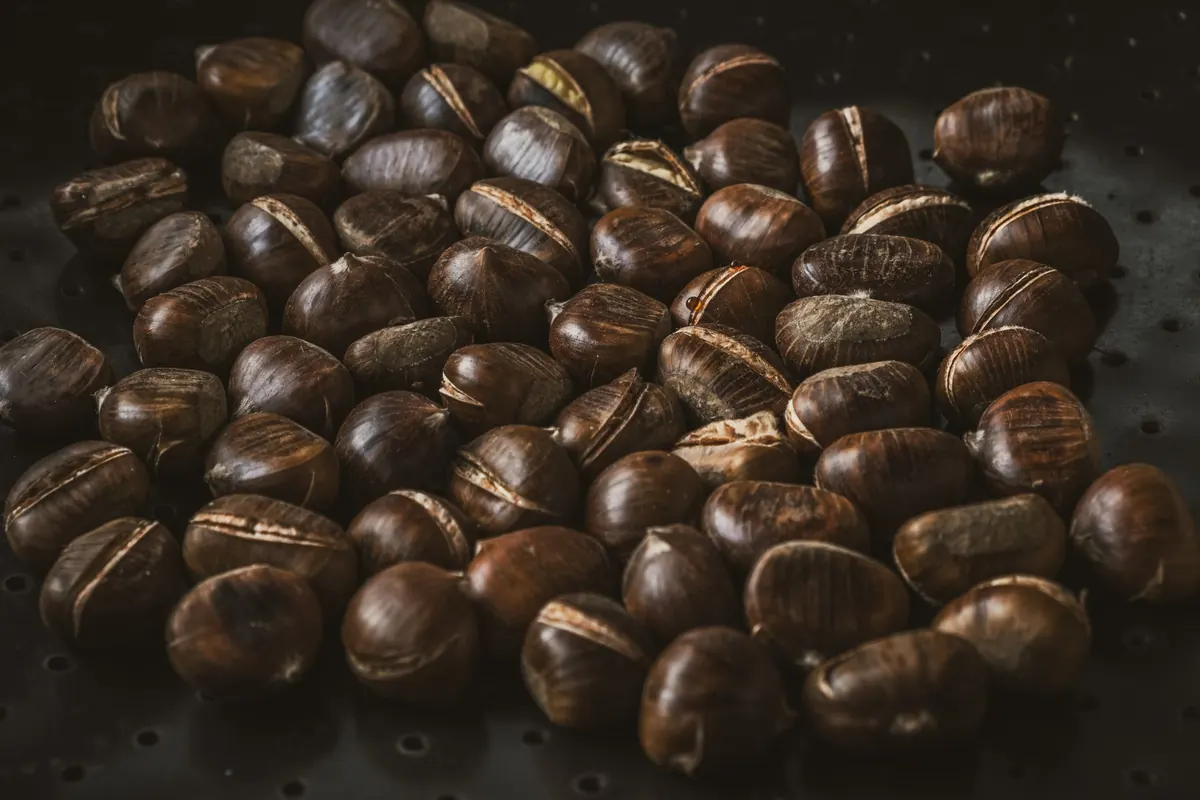
One practical note: horse chestnuts are not sweet chestnuts. They are not edible, so keep them out of reach of pets and small children who chew things.
Making the hole
An adult should handle the drilling, or at least supervise it. Push a nail or skewer through the centre, working from the eye outward if you can, twisting as you go. A slow drill is neater. Go gently — conkers split easily if you force the hole through.
Threading and knotting
Tie a knot at one end that cannot pull back through the hole. A figure-of-eight knot or a double overhand works; a bead or washer under the knot is safer still. Leave roughly 20 cm of string above the conker. That length matters. Too short and you cannot swing properly, too long and your conker drags on the ground or cracks against your own shin. The loose end goes around your hand, never around your wrist.
Hardening, if you must
The old methods — a year in a dark drawer, a soak in vinegar, a coat of clear nail varnish — are traditions rather than requirements, and competitions generally ban varnish. A firm, well-dried conker does the job. Skip the oven: it is a fire risk and the smell lingers.
Setting Up: The Toss and the Stance
Decide who strikes first. A coin toss is fairest. Playground tradition sometimes hands first strike to the owner of the newer conker or to the challenger, but the toss settles it without arguments.
The player being hit holds their conker out at arm's length, letting it hang at about chest height. Hold the string between thumb and forefinger, keep it steady, and keep your hand clear of the swing path. Your job is to be a post, not a participant.
The striker wraps the loose end of their string once or twice around their fingers and lets the conker hang free. Both players stand side-on, feet planted, about an arm's length apart — close enough to reach, far enough that you are not smashing knuckles.
Taking Turns: Striking, Missing and Losing Your Go
The game is one motion, repeated. Pull the conker back and swing it down and through the target. Keep a little tension in the string on the way down; a flopping conker arrives with no weight behind it.
- Check the target is still. Ask them to stop fidgeting.
- Pull your conker back to about shoulder height, arm fairly straight.
- Swing down in a straight line through the dangling conker, not across it.
- Follow through, then let your conker settle before pulling it back.
- If you connected, the strike counts. If you missed, you have had your go.
The most common version gives each player one swing per turn, hit or miss, and then passes the turn. Plenty of groups play three swings per turn instead, which gives the striker a chance to find their range. Agree which you are playing before the first strike.
Legal and illegal swings
Only the swing is allowed. A stamp — pressing your conker straight down onto your opponent's — is a foul in every version worth playing, and so is trapping their conker against your hand and twisting it. So is lifting the target by pulling the string upwards, or holding your own conker still with your free hand to add force. If you have to invent a technique mid-swing, it is probably a foul.
How You Win a Game
There are three ways to take the game.
- You break their conker. A crack that splits it or takes a chunk off is a win.
- Their conker comes off the string. Usually the knot pulls through the hole. You win.
- Their string breaks. You win, though many groups allow a quick re-thread and carry on.
If both conkers break on the same swing — a genuine double — most players call it a draw and start again.
Keeping score
Conkers carry their record with them. One that has won a single game is a one-er; two games, a two-er. By tradition, beating an experienced conker adds its record to yours, so a fresh conker that breaks a three-er becomes a four-er. Write it on the shell in marker if you are serious about it, or just remember.
Fouls, House Rules and Safety
Settle these before the first swing, not after the first argument:
- How many swings per turn — one, or three
- What a foul costs: the turn, or a free strike for the opponent
- Whether a broken string can be repaired mid-game
- Whether hardened or varnished conkers are allowed
- Whether you can swap conkers between games
- Match length: best of three, best of five, or until someone is called in
On safety, keep it simple. Swing low and never aim at a head or face. Stop the moment anyone says stop. Check your string for fraying, because a snapped lace whipping back stings. And remember the game is swinging at a small target, not at each other — a conker thrown hard does real damage.
Your First Game, Start to Finish
Pick two firm conkers. Thread each on about 20 cm of string and knot the end securely. Toss a coin for first strike. Stand an arm's length apart, one player holding their conker out steady while the other swings. If a conker splits or drops off its string, the other player wins the game and the winning conker earns its first stripe.
Ten minutes of play is usually enough for a first session, and a best-of-three settles most afternoons. Agree your house rules first, and the only thing left to argue about is whether that last swing was really a stamp.
Photo: Antonius Ferret / Pexels